
You will usually have your cervical screening test at your GP surgery or at a registered clinic. You decide where you want to have it. During cervical screening a small sample of cells is taken from your cervix for testing/screening. The test itself takes about 5 minutes. The whole appointment should take approximately 15 minutes.
It is better to book an appointment (this link will take you to hse.ie) when you do not have your period as this can affect results.
Giving your informed consent
Each time you have a screening test you will be asked to:
- confirm you understand the information you have been given about cervical screening
- give your consent to take part in CervicalCheck
You do this by signing a form called a cervical screening form. You will be given information and the form at your appointment.
If you would like to see this form you can download the form here (this link will take you hse.ie).
Take time before your cervical screening test to read it. Check that your name, address and other details are correct. If you have any questions, this is a good time to ask.
Sign the consent form when you feel you have all the information you need to make an informed decision.
You should understand:
- the benefits and limitations of screening
- the possibility that your sample may also be tested for abnormal cells
- the likelihood and meaning of a normal result
- what it means if you are called back for further tests
- when and how you will get your result
- how your personal information will be used
- that your health care practitioner receive, hold and exchange your personal information with those who deliver the cervical screening programme
Most of this information will be given to you with the consent form. The information is also here on mycervicalscreening.ie and on the HSE’s website (this link will take you to hse.ie).
Only you can give your consent. If you cannot sign the form, you will be asked to give your consent either verbally or by making a mark on the form.
Withdrawing your consent
You can withdraw you consent at any time by contacting CervicalCheck here (this link will take you to hse.ie).
How cervical screening is done
The GP or nurse will ask you to undress from the waist down and lie down on a examination table, similar to a narrow bed. You can usually remain dressed if you are wearing a loose skirt. But you will still have to remove your underwear.
You will be asked to lie on your back with your legs bent, feet together and knees apart. But you can lie on your side if it ia more comfortable for you.
When you are ready for the test:
- They gently put a smooth, tube-shaped tool (a speculum) into your vagina – this holds the walls of the vagina open. They may use a small amount of lubricant.
- They open the speculum so they can see your cervix.
- Using a soft brush, they take a small sample of cells from your cervix.
- They remove the speculum and leave you to get dressed.
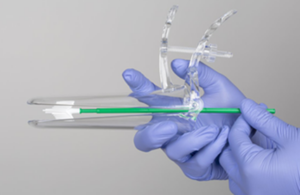
A speculum (plastic or metal) and soft brush are used to take a sample of cells from your cervix
Some women find the screening test slightly uncomfortable, but for most it is not painful. If you anticipate that you may find it challenging, please let your health care professional know prior to the beginning of the insertion as they will explore other options with you. If you experience vaginismus (a tensing of your vaginal muscles that is out of your control) please see separate article about vaginismus.
Some may find the test embarrassing; this is normal and natural. What is important to remember is that screening saves lives, that life could be yours and there is nothing embarrassing about that.
Your sample is placed in a small container and send to a laboratory (lab). The lab will check the sample for HPV first. If HPV is found, the sample will also be checked for abnormal cells.
Things that can make the test more comfortable
Things you can try that might make the test better for you include:
- bringing someone with you for support – check when booking that it is ok to bring someone
- wearing something you can leave on during the test, like a skirt or long jumper
- asking the GP or nurse to use a smaller speculum
- asking the GP or nurse to use a lot of lubricant if you have vaginal dryness (this link will take you to hse.ie).
- telling the GP or nurse that you want to lie in a more comfortable position to have the test
- taking slow, deep breaths to help you relax
- letting the GP or nurse know during the test if it is painful
If you are taking testosterone
Your screening test may be uncomfortable if you are taking long-term testosterone. There may be physical changes to your body, particularly to your genital area.
Talk to your GP or nurse. They can help make the test more comfortable for you.
Things to look out for after cervical screening
You may have some spotting or light bleeding after your test. This is very common and should go away in a few hours.
Speak to a GP if you have:
- heavy bleeding after cervical screening
- any bleeding after cervical screening that does not stop after a few hours
- any bleeding that happens after a year since your last period (medical menopause)
Acknowledgement
This page contains information based upon content from reliable sources including the HSE’s website (this link will take you to hse.ie).