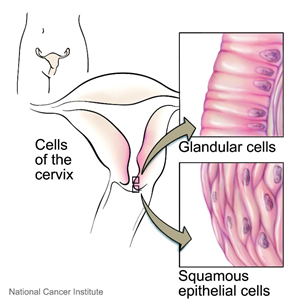
Cervical cancer is a cancer of the cervix. It occurs when the cells of the cervix become abnormal and slowly overtime become cancer. Abnormal cells are sometimes called pre-cancerous cells and terms used to describe these pre- cancerous cells are called CIN or cervical intraepithelial neoplasia. CIN are graded on how abnormal the cells appear, the higher the grade the more abnormal the cells appear and the greater the depth of abnormality. CIN 3 means full thickness of the surface layer if affected. These abnormal cells are usually detected by colposcopy and the term used to describe the presence of abnormal cells is called dysplasia.
- CIN 1: Mild dysplasia
- CIN 2: Moderate dysplasia
- CIN 3: Severe dysplasia or carcinoma in situ (CIS) whilst this sounds like a cancer, it is not a cervical cancer
These early changes will return to normal but for some they can continue to advance over the years and cause cervical cancer to develop. Whilst CIN 2 and CIN 3 have a higher risk of becoming a cancer it is important to remember not everyone with CIN 1, 2 or 3 will develop a cancer and one the ways to reduce this risk is to attend routine cervical screening. CIN is usually asymptomatic and is detected by routine cervical screening.
Types of cervical cancer
There are different types of cervical cancer:
- Squamous Cell Carcinoma: Squamous cells are the flat, skin-like cells that cover the outer surface of the cervix (the ectocervix). This is the most common type with between 70 – 80 out of every 100 cervical cancers (70 – 80%) being this type.
- Adenocarcinoma: This cancer starts in the gland cells that produce mucus. The cervix has glandular cells scattered along the inside of the passage that runs from the cervix to the womb (the endocervical canal). Adenocarcinoma is less common than squamous cell cancer but has become more common in recent years. Around 20 in every 100 cervical cancers (20%) are adenocarcinomas. They tend to be treated in the same way as squamous cell cancer of the cervix.
- Small Cell: A very rare type of cervical cancer. Around 3 in every 100 women (3%) are diagnosed with cervical cancer have this type. Small cell cancers tend to grow quickly and are treated in a different way to the more common types of cervical cancer.
- Other Rare Types: Very rarely, other types of cancer can occur in the cervix. For example, lymphomas and sarcomas. They are treated in a different way to squamous and adenocarcinoma cervical cancers.